CTM Chart Method


Freud’s ideas about human instincts and desires—particularly the drive to be happy or satisfied—can be connected to mindfulness. Freud believed that our unconscious desires drive our behavior, but he never fully explained how these instincts relate to more complex behaviors, like the pursuit of happiness without relying on others. Mindfulness helps to explain this by giving us the tools to understand and manage our instincts in a healthy way, without letting them control our actions.
Disbelief and discomfort are other ways the mind tries to assert control. While skepticism can protect us from being deceived, it can also prevent us from connecting with others or growing as individuals. While discomfort can stop us from making any sudden movements or decisions, it can also prevent us from connecting with others or growing as individuals. To move past this, we need to shift from trying to control our disbelief to embracing trust. Trust isn’t about blindly accepting everything; it’s about accepting uncertainty and learning to be okay with not knowing everything. This shift allows us to experience life more fully and create meaningful connections, even in the face of discomfort.
Instead of fighting discomfort, CTM encourages us to accept it as part of life. Embracing discomfort allows us to better understand ourselves and the world around us, and this is the same for any sort of cognitive discomfort which may be caused by disbelief. By learning to be comfortable with uncertainty, and trusting our ability to handle whatever comes our way, we can build resilience and gain clarity, even when life feels unpredictable. It’s through this trust that we can embrace life’s full potential.
Consistent practice of CTM tunes individuals to their core values and principles. Over time, this alignment ensures that most thoughts naturally adhere to these internalized guidelines. This frees mental resources to focus on action and reflection rather than constant evaluation. By categorizing impulsive reactions as unformed “pre-thoughts” rather than actual thoughts, CTM provides a mechanism for ignoring or redirecting them before they can influence decision-making. This simplifies the cognitive process by removing distractions early.
The ego, according to Freudian psychology, is not purely objective. It acts as a mediator between the id (our instinctual desires), the superego (our moral conscience), and reality. The ego assesses the outside world and adjusts our behavior accordingly. Sometimes the ego creates thoughts that feel justified, but these thoughts can also cause anxiety or arrogance. Focus and determination can cause arrogance, depression, or confusion in tough situations where a clear objective is yet to be identified. But by choosing to trust love and passion-driven perspectives instead of letting the ego dictate your thoughts, you can form a goal that is relevant to the situation. This allows personal growth, creativity, emotional openness to again take over as the primary internal factors in that situation.
CTM helps you understand why relying solely on your ego can make life feel more like a balancing act than a place to enjoy, learn from, and find peace in from time to time. The color-coded structure highlights key connections between concepts within the CTM framework, serving as a starting point to guide your understanding of what mindfulness is capable of, and what ultimately your mind is capable of improving on. Cognitive Transformational Mindfulness (CTM) trains individuals to recognize and develop eight essential qualities—Power, Cognitions, Balance, Understanding, Organization, Excellence, Courage, and Recovery—not as static traits, but as dynamic expressions of a self-organizing consciousness, and this chart is a starting point for building the confidence and competence to work towards developing these.
Before filling out the chart, the goal is not to overanalyze—but to honestly observe how your mind already functions, both in meditation and in everyday thinking. To determine which concepts belong in each color, you can begin by asking yourself a few simple but revealing questions. First, for green, ask: What do I consistently leave out when I try to be mindful? What part of thinking, feeling, or awareness do I avoid, overlook, or disconnect from during meditation? For yellow, ask: What do I rely on the most to believe in my myself when I use positive self-talk, or mantra? Also, if you are having difficulty thinking about what it’s like to meditate or what meditation really is, simply consider which of these qualities helps you to stay committed to working towards something with the process of believing in yourself being the anchor for your mind? For purple, ask: When I am under stress or thinking deeply, what actually helps me stay grounded, present, and engaged? What allows me to reconnect passion with presence when things become difficult? These questions are not meant to produce perfect answers, but to reveal patterns. The chart works best when it reflects your natural tendencies, because CTM is not about forcing change—it is about recognizing how your mind organizes itself, and then strengthening the areas that bring it back into balance and coherence. Green represents the category that you most often leave out of your meditative thought processes, that is ok, as this aspect will naturally be brought up in times that you practice mindfulness without an objective (traditional mindfulness) and your cognitive abilities to approach this aspect will most likely be able to remain steadier and stronger as a result of the time you spend using CTM. Yellow represents the categories you see as most important to believing in yourself and whatever your internal dialogue is saying about yourself. These must be represented as two in one column and one in each of the other columns. The column you choose to put two concepts highlighted in yellow, cannot be the same as the column which you chose to highlight in green. This is important because green represents what you tend to leave out, while yellow represents what you rely on most to stabilize and believe in yourself. If both were placed in the same column, you would be reinforcing and neglecting the same functional area at the same time, which creates confusion rather than balance. Purple represents the remaining concepts, which become the principles most meaningful for creating a mindful perspective in stressful situations or situations where deep thinking is required. These concepts will also mathematically be represented as two in one column and one in each of the others. Purple represents how you use your mind—not just the brain’s structure, but the lived experience of awareness itself—to remain realistic, present, and growth-oriented. The mind, in this sense, is the dynamic field of awareness: how you experience meaning, emotion, interpretation, and presence in real time. While the brain helps you maintain direction, the mind helps you stay connected. Purple reflects the qualities that allow you to reconnect passion with presence, especially when stress disrupts that connection.
The reason the column with two concepts highlighted in purple is always responsible for being the primary driver is that this identifies where the deepest convergence of passion and presence occurs. This is where awareness is most capable of reorganizing itself under pressure—where thinking, feeling, and meaning come back into alignment.
Understanding the distinction between brain and mind is essential to understanding why this chart works. The brain stabilizes; the mind interprets. The brain reinforces; the mind experiences. The brain holds direction; the mind gives it meaning. CTM works by bringing these two into cooperation, so that what you know, what you feel, and how you act begin to align.
The next article will explore this distinction more deeply—breaking down how the brain and mind interact within CTM, and how strengthening their relationship can significantly improve clarity, resilience, and self-directed growth.
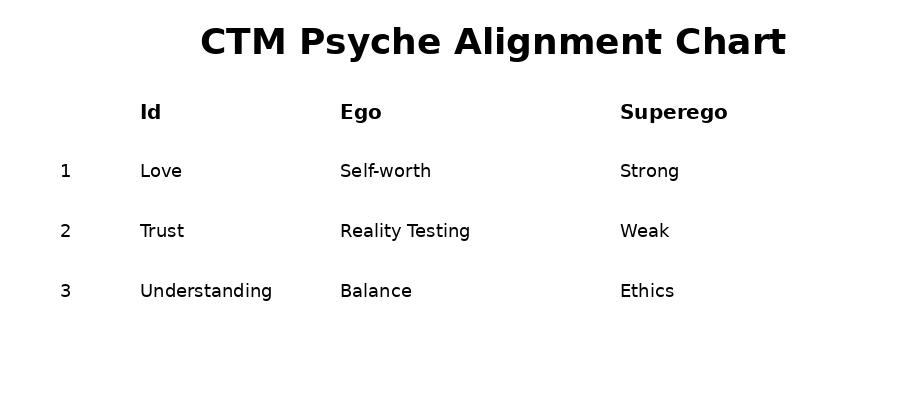
The CTM chart is meant to teach someone which is their primary driver, so they know what their mindfulness practice would focus on, without using BRIDGE, instead the knowledge of what their primary driver should focus on, to make transformations of whatever is needed. If CTM were primarily Id-driven for someone, their mindfulness practice would likely focus on emotional release, instinctual awareness, and embracing desires without excessive self-judgment. If CTM were primarily Ego-driven it would generally involve rational self-reflection, adaptability, and intentional cognitive transformation. If CTM was primarily Superego-driven for someone, their mindfulness practice would likely focus on ethics, moral reasoning, and aligning thoughts and behaviors with deeply held values. Your primary driver may change over time, and you can do this chart test as often as you want, to check if there are any changes. Although, I do not know for sure, I theorize that what is your primary driver should change over time, and for people that this does not change over time for, it may be the cause of them feeling stuck, it may cause just their body to feel stuck which would lead to physical health issues (if they become comfortable with only developing intellectually and begin to not grow their brain in other ways), or it may be the cause of development of any type of mental illness. CTM works to re-create a mind that changes from time to time, which would allow this stagnation to unlock flow for those experiencing stagnation, or other issues caused by becoming stagnant. Also, sometimes under extreme stress these concepts can completely disconnect, causing difficulty thinking, dissociation, anxiety, fear, and even long-lasting depression or other mental health symptoms. CTM works by allowing each aspect of the psyche to be carefully refined by expanding the limits of each psychological structure through carefully working to examine the overlaps which exist and allowing them to exist peacefully for as long as they keep providing psychological depth, philosophical development, or for developing guidelines. This is possible by developing comfort with the aspect of the psyche which is most often used as the primary driver in mindfulness practices and developing greater awareness of the level of discomfort you have with the category highlighted in green which is the category which is left out of your meditative process most often. In other words, rather than forcing separation between the Id, Ego, and Superego, CTM encourages individuals to:
Examine where these aspects intersect.
Allow them to coexist peacefully.
Use them for growth, transformation, and balance.
This means that as long as these overlaps provide psychological depth, philosophical development, or ethical guidance, they are not seen as conflicts but as opportunities for greater integration and self-awareness. This allows the brain to become whole, and the body to become interested in connecting more with the brain in any way it can. CTM becomes a fluid method for expanding consciousness, helping individuals navigate their personal drives, personal philosophy, and personal guidelines, so that they promote a focused sense of peace without structure, but with clarity and intentionality.

For CTM, the aspect of the psyche which primarily drives it is also the aspect of the psyche which is used to make transformations of cognitive patterns, physical actions, and cognitive beliefs. If CTM were primarily Id-driven for someone, their mindfulness practice would likely focus on emotional release, instinctual awareness, and embracing desires without excessive self-judgment. This might mean using mindfulness to connect deeply with emotions, enhance creativity, or manage impulses in a healthy way rather than suppressing them. Their approach to CTM would prioritize self-compassion, acceptance of pleasure, and recognizing how instinctual drives influence thoughts and behaviors.
If CTM was primarily Superego-driven for someone, their mindfulness practice would likely focus on ethics, moral reasoning, and aligning thoughts and behaviors with deeply held values. They might use CTM as a way to cultivate self-discipline, a strong sense of responsibility, and an internal moral compass to guide their actions. This person may emphasize mindfulness techniques that reinforce ethical decision-making, self-restraint, and a commitment to social or philosophical ideals. Their practice would be less about managing impulses (Id) or balancing self-worth with reality (Ego) and more about ensuring their thoughts and behaviors align with their highest principles.
If CTM was primarily Ego-driven, the principles that are most meaningful for creating a mindful perspective in stressful situations, or situations where deep thoughts are required will often require an understanding of self-worth and reality, so that weaknesses don’t allow for stressful situations to be unmanageable. So, for this person, CTM will generally involve rational self-reflection, adaptability, and intentional cognitive transformation. The reason I named this mindfulness practice Cognitive Transformational Mindfulness is that I saw mindfulness as something that actually can be practiced while using the ego if done right. I also knew one of the main ways mindfulness can be practiced with the ego is through intentional cognitive transformation, and I also knew using intentional cognitive transformation to build a framework can allow me to understand what else mindfulness can be used for(how it can be used to work with other aspects of the psyche and determining what qualities actually allow someone to make transformations of cognitive patterns, physical actions, and cognitive beliefs, and what aspect of the psyche those qualities align with). Building a framework for anyone to understand how they can accept what mindfulness can be used for was easiest to do keeping in mind that cognitive transformation is not always intentional, but having an awareness of what allows for it to occur can only be done with conscious engagement of the ego—through reflective awareness that observes, organizes, and intentionally works with the processes shaping thought, behavior, and belief in real time. This allowed me to explain how mindfulness can be used for what it is (a process that refines and informs perception, and not just a process that informs perception like CBT claims, or refines perception like DBT teaches you to accept) while also working to improve mental health, the physical relationship we have with the world, and the way we determine our behavior.
This approach fundamentally shifts the purpose of meditation from detachment to integration, using the primary driver as a pathway for intentional growth and self-awareness. This distinction highlights a key difference between CTM and other meditation practices—while traditional meditation often seeks to transcend or detach from psychological structures, CTM embraces the primary driver as an essential tool for transformation. The reason CTM’s primary driver is directly connected to transformation, while other forms of meditation emphasize overcoming reliance on the primary driver, comes down to the fundamental goalsetting nature of each practice. By making this distinction, the practitioner can refine their approach, ensuring that their meditation practice actively integrates new perspectives rather than reinforcing familiar mental loops. This awareness also encourages patience, as it reminds individuals that achieving a meditative state is a process that requires intentional shifts in focus, perception, and emotional engagement.
Synthesis: Mastery Over the Self
By combining a stable, mindful focus (the steady awareness of the breath) with a deliberate reflection on the dynamic, chaotic aspects of your inner experience, your version of clarity allows you to:
Master Your Inner Processes:
Engage with your dominant psychological driver—whether it be the rationality of the Ego, the raw impulses of the Id, or the ethical vigilance of the Superego—and transform it into a resource for growth.
Transform and Integrate:
Rather than striving to detach from or suppress any part of your psyche, you work with it. This integration is the pathway to individuation (Jung) and to the liberating insight of non-self (Buddha). You learn that true mastery involves embracing and transforming your inner dynamics rather than transcending them in a way that disconnects you from your lived reality. This forms a trust that isn’t blind optimism—it’s a lived truth that the mind no longer needs to resist itself. It learns to witness, to soften, to hold both tension and release with equal respect. In this space, clarity arises not as a rigid conclusion, but as an ongoing relationship with experience. It invites curiosity, invites presence, and allows us to step into life not with avoidance, but with responsiveness.
At times, this confidence may express itself through a sense of calm neutrality, at other times through joyful insight or renewed direction. It is flexible, fluid, and deeply human. It holds within it the strength to pause, the courage to let go, and the wisdom to act when needed—not from compulsion, but from intention.
And as this confidence deepens, the mind and body begin to unify. The breath flows more freely. The muscles let go of what they were holding unnecessarily. The nervous system recalibrates, no longer caught in old loops of fear or control. The heart, too, begins to open—not just emotionally, but energetically, allowing us to feel life more completely.
Eventually, we begin to understand: this whole process—the self-talk or use of a mantra, the awareness, the balance, the transformation—was never about reaching perfection. It was about remembering wholeness. And with that remembrance comes a profound sense of freedom: not the freedom to escape life, but the freedom to be fully present within it.
Respecting the nature of how mindfulness connects to moment-to-moment thoughts you have (like CTM teaches you without the need to overthink), balances out the psyche, empowers the body, and transforms the confidence we have in our own mind. It can transform the confidence in many ways, such as making it stronger, making it believe truth is freeing, making it believe change is always possible, or in many other ways. This confidence can come with clarity, or it can come with motivation, authenticity, or the release of tension. This confidence naturally begins to reshape our inner narrative—not by force, but by resonance. It doesn’t demand control over every thought or emotion but rather it creates a safe internal space where those thoughts and emotions can be seen, heard, and harmonized. As the psyche aligns with this quiet, strengthening confidence, it becomes easier to trust the moment, even when it feels uncertain. I believe the reason so many people have difficulty with meditation is they are unamused or uncomfortable with the way these categories are connected for them, and as soon as the meditative thought process begins the person’s mind will both consciously and unconsciously look for reasons to find distrust, boredom, or an increased sense of detachment as these states of consciousness begin to feud with one another instead of fusing with one another. Reminding yourself that you are who you are—that your past cannot be changed, and your future remains uncertain—can feel daunting, especially when craving or rumination becomes a regular pattern in your mind. The chart method allows a person to view their consciousness from a clear lens with clarity. CTM practices work to expand this lens and deepen the lenses ability to remain useful in any situation. While balance can certainly be connected to the Superego in terms of creating and trusting ethical ideals, for CTM it’s more useful to place it within the Ego, where it becomes an active, adaptive process of self-regulation, emotional awareness, and real-time decision-making, and when ethics naturally get brought into the situation, then you can connect your need for balance with the Superego. This is why for mindfulness for transformation, conditioning, or reorganizing, it’s more useful to place the term balance in the category of the Ego, with the understanding that there are many facets of balance. Each facet of balance represents a different way the Ego organizes experience in real time rather than enforcing a single fixed ideal.
Balance, in this sense, is not one thing—it is multidimensional.
There is emotional balance, where the Ego allows feeling to be present without becoming overwhelmed or suppressed. Here, balance means staying connected to emotion while maintaining enough stability to respond rather than react.
There is cognitive balance, where thoughts are neither rigid nor chaotic. The Ego learns to organize interpretation without over-identifying with it, allowing perspective to remain flexible and clear.
There is attentional balance, which becomes especially important in mindfulness. This is the ability to shift between focus and openness—between what CTM would describe as focal and peripheral awareness—without getting stuck in either. The Ego regulates where attention goes and how long it stays, making awareness usable rather than scattered.
There is behavioral balance, where action reflects alignment rather than impulse. The Ego translates awareness into movement, helping a person act in ways that are coherent with their understanding rather than driven by urgency or avoidance.
There is also relational balance, where the Ego helps navigate the space between self and others. It allows a person to remain grounded in their own experience while still being open, responsive, and connected to external influence.
And importantly, there is temporal balance—the ability to remain connected to both the present moment and longer-term direction. This is where CTM’s emphasis on progress becomes especially relevant. The Ego helps hold continuity over time, allowing a person to remember what matters, return to it, and build from it rather than being pulled entirely into immediate emotional states.
But within each of these forms of balance, there are even more specific forms of balance related to thinking itself.
For example, within cognitive balance, there is the balance between analysis and intuition—knowing when to think something through and when to trust what is already understood. There is the balance between certainty and openness, where the mind can hold a clear direction without becoming closed off to new information. There is also the balance between depth and efficiency—when to explore something fully and when to move forward without overprocessing.
Within emotional balance, thinking also plays a role through the balance between interpretation and direct feeling. The Ego learns when thought is helping clarify emotion and when it is distorting or amplifying it.
Within attentional balance, there is the balance between holding a thought and releasing it—the ability to stay with an idea long enough to understand it, but not so long that it becomes fixation or rumination.
Within temporal balance, there is a thinking-related balance between short-term evaluation and long-term meaning—the ability to assess what is happening now without losing sight of where things are going.
Even within behavioral balance, there is a cognitive layer: the balance between planning and acting, where thought supports action without delaying it unnecessarily.
In mindfulness, these thinking-related balances become more visible because thoughts are no longer completely automatic. They begin to arise in a way that can be noticed, assessed, and used in real time. The Ego becomes capable of shaping not just what is done, but how thinking itself is structured and applied.
This is what makes balance dynamic rather than static.
Instead of asking, “Am I balanced?” the practitioner begins to sense:
How is my thinking operating right now?
Is it helping organize experience or fragmenting it?
What adjustment would bring it back into alignment?
This is why placing balance within the Ego is so useful in CTM. It allows balance to become active, adaptive, and responsive, extending all the way down into the structure of thought itself.
And when ethical considerations arise, the Superego can still inform this process—but it no longer dominates it. Instead, it becomes integrated through the Ego’s ability to regulate, interpret, and act across all these layers.
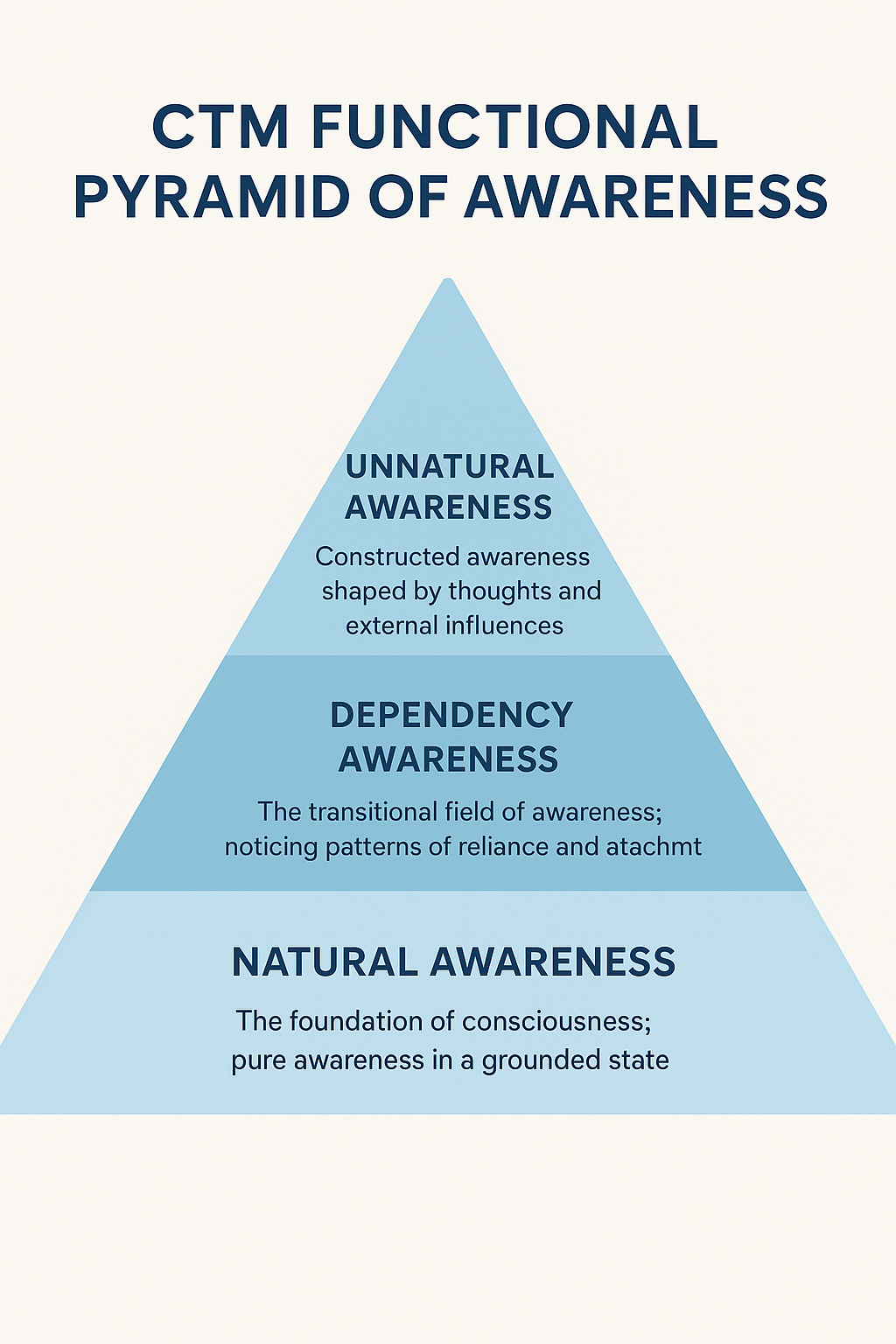
In this way, balance becomes less about achieving perfection and more about maintaining coherence across changing conditions, including the continuous refinement of how we think, feel, and respond in real time. Positivity influences how much love, trust, and understanding you must embrace in order to balance trust and control. Trust always requires acknowledging any thoughts and emotions related to the situation as they present themselves, and control will require different things depending on the situation. When considering these terms within the Triune Pyramid of Functional Awareness, trust is placed at the bottom level, control at the middle level, and trust within control is placed at the top level.